
Alaska: Humpback Whales: Bubble-net Bonanza 2023
19th – 30th March & 27th March – 7th April 2023
Every new tour begins with a healthy serving of anticipation and expectation. This is also accompanied with tinges of uncertainty and even trepidation. And the latter are, all the more, acute if the tours goals are primarily focused around seeing and photographing a single species, event or particular aspect of behaviour. So, it was with the recent Bubble-net Bonanza tours to Alaska.
These were the first photo tours I’d been involved with to southeast Alaska and were conceived during Covid lockdown three years prior. Despite, meticulous planning, and repeated assurances from our expert partners on the ground that we would definitely see bubble-net feeding humpback whales, it was natural to have doubts as we set off from the dock in Sitka harbour on day one.
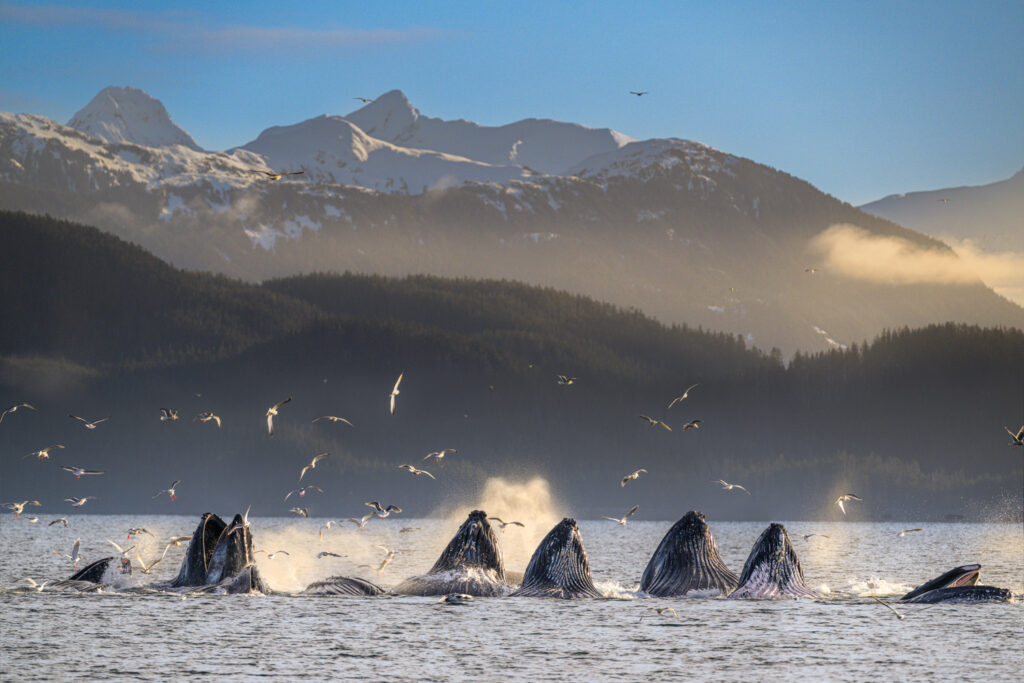
Within the first couple of hours on our first morning, we had seen numerous bubble-net feeding events like this. © Nick Garbutt
The tours had been timed precisely. Humpback whales pass through the waters around Baranoff Island near Sitka while migrating from their warm water calving grounds off Hawaii or Mexico en route to their high summer feeding grounds further north. They stop to take advantage of the prolific herring run, that offers the first opportunities for the whales to feed for several months. The herring gather in vast quantities to spawn in shallow coastal waters from mid-March to around mid-April and the whales’ time their arrival to coincide with this this. Our partners have kept accurate records of bubble net feeding in the area, and stated with confidence that the behaviour has started on 19th / 20th March each year for the past decade. Our first tour arrived in Sitka on 21st March. We were met by Neil, our boat captain and local whale expert, who immediately informed us that there were already plenty of whales in the area and that the bubble-net feeding had started.
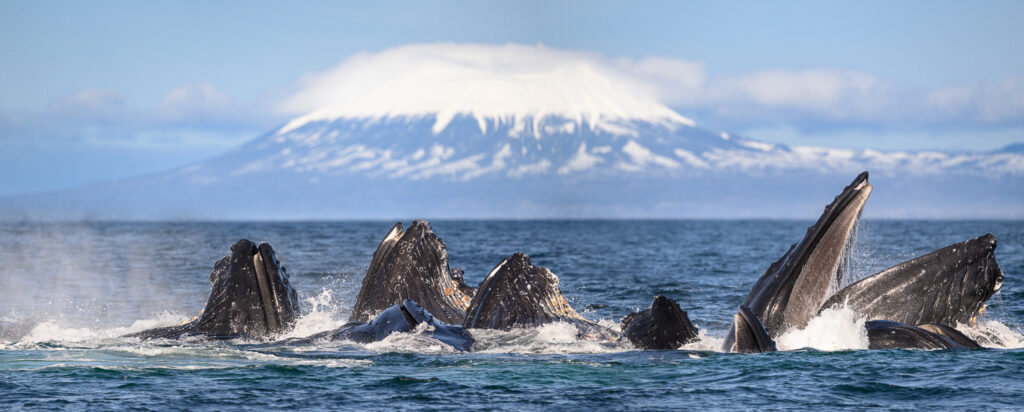
On clear days (mainly during the second tour), Mount Edgecumbe provided a stunning backdrop © Nick Garbutt
The following morning, we left the harbour at 7.00am and by 7.10am had seen our first humpback whale, a lone individual feeding in waters just north of town. Neil suggested we not spend too long watching, and that we should continuing heading to an area a short distance away, around the other side of one of the many offshore islands in Sitka Sound. After another 20 minutes of sailing, we arrived in calmer waters and in the distance could see numerous whale blows clustered together. It looked promising. As we approached, there was no way of knowing when or where the whales might again appear. Would they simply surface for air, or would they actually feed? Within a couple of minutes, we had the answer – some 100m away front left of the boat, with barely any warning, a pod of humpback whales erupted at the water’s surface, mouths gaping wide, water cascading from their clearly visible baleen plates. There was an audible gasp and intake of breath from us all. Wow! As the whales slowly sank back into the white frothy waters they had creates, flocks of gulls and bald eagles gathered above, looking to pick off any hapless herring left at the surface. It was a feeding frenzy below and above the waves.
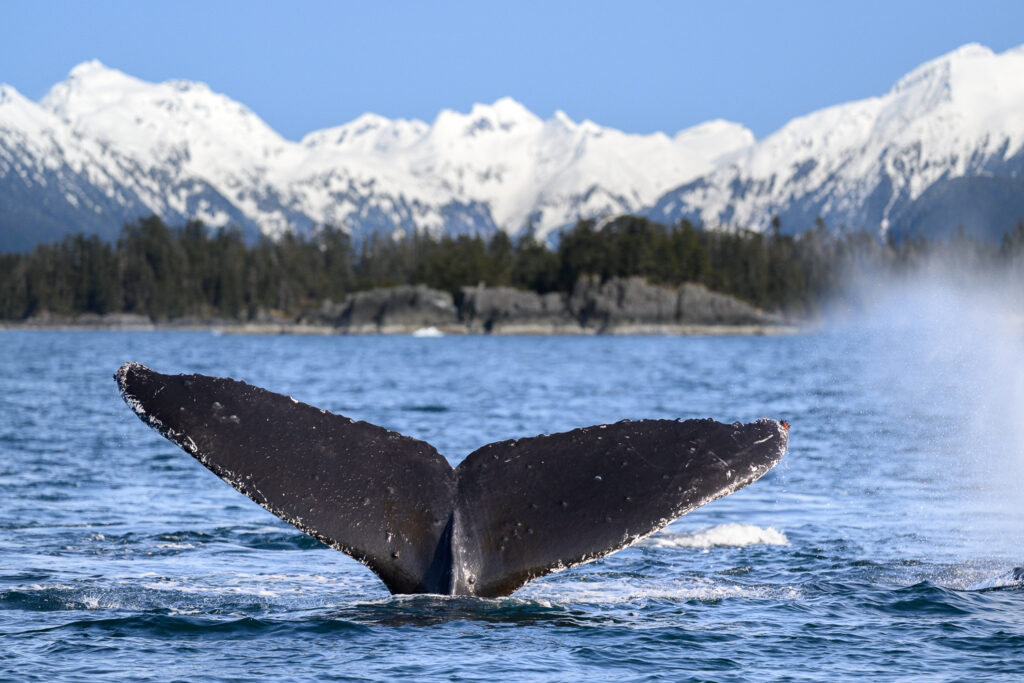
A humpback whale descends to the depths © Nick Garbutt
A glassy calm returned to the water’s surface, the flocks of birds dispersed, and everyone looked around eagerly wondering when and where it might happen again. Neil was bombarded with questions. How long would the whales stay down for? How deep will they dive? How far might they swim before re-surfacing? There were no definitive answers to any of these questions. We just had to wait and see – and guess.
Over the next couple of hours or so, the whales bubble-net fed repeatedly, sometimes emerging three or four hundred metres away, but at other times as close as 50m from the boat. We kept our eyes peeled, constantly scanning the sea’s surface for tell-tale bubbles, fleeing herring leaping from the water or other disturbances to the surface that might give us a second or two warning where the whales might emerge. It quickly became apparent that the flocks of gulls could be good indicators, as they’d sometimes suddenly rush towards an area prior to the whales feeding. But they we not infallible, so at other times the whales would emerge and neither the bird flocks nor ourselves managed to pick up any signs.
After only three hours on the water, we’d seen over 20 bubble-net feeding events and were in no doubt how spectacular the phenomenon was to witness close hand. By late morning the pod of whales began to fragment and disperse, probably because the herring shoals had become harder to locate.
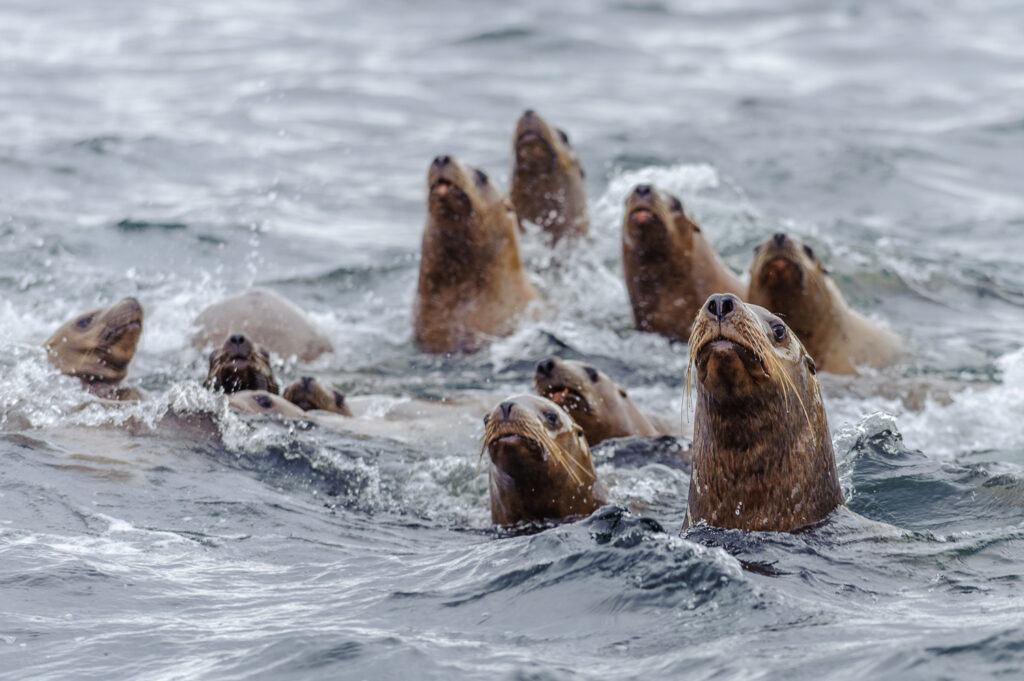
A noisy inquisitive group of Stellar's sea lions © Nick Garbutt
We moved away to explore waters around one of the other offshore islands and look for some different wildlife. In a bay, where the water shallowed and dense kelp beds broke the surface to form waving rafts, there were gatherings of noisy Stellar’s sea lions and large numbers of sea otters. The otters were way more numerous than I’d imagined, in one small area I counted over fifty heads bobbing at the surface, although they were also quite shy and dipped below the waves if the boat drifted closer than 30m away. The bird life too was prolific: rafts of surf and white-winged scoters were often encountered, along with pigeon guillemots, common murres, double-crested cormorants and pelagic cormorants.
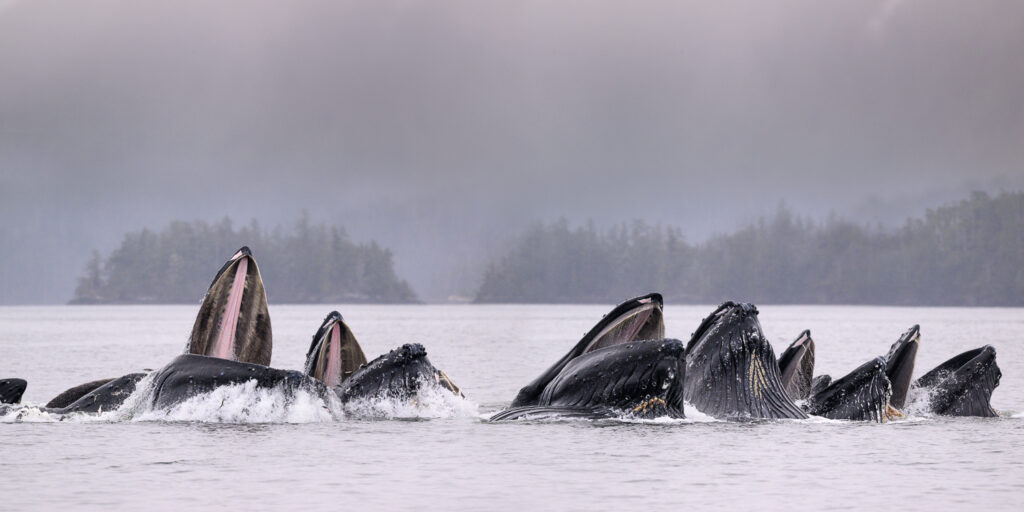
There was considerable day-to-day variation in humpback feeding behaviour. On some day larger groups of whales aggregated and would lunge high out of the water © Nick Garbutt
After lunch we returned to the area where the whales had been feeding. In a short time searching, we found another active pod not too far away. It was clear from the boat’s sonar read outs that there were large herring shoals beneath us, and the whales had once again found them. If anything, the subsequent two hours was even more frenetic than the period we had witnessed in the morning. After lunging through the sea’s surface, the whales would take no more than half a dozen breaths before diving again, then re-emerging a couple of minutes later with mouths gaping. It became a steady rhythm and with the hydrophone in the water we could listen in on their haunting calls. There are few more mystical sounds in nature than whale song. With each dive the pitch and cadence of their calls would vary slightly, but each time they neared the surface the call frequency and pitch would increase and built to a crescendo, until they fell silent just prior to breaking the surface. This at least gave us a hint as to when to ready ourselves, but there was still no way of predicting where they might appear.
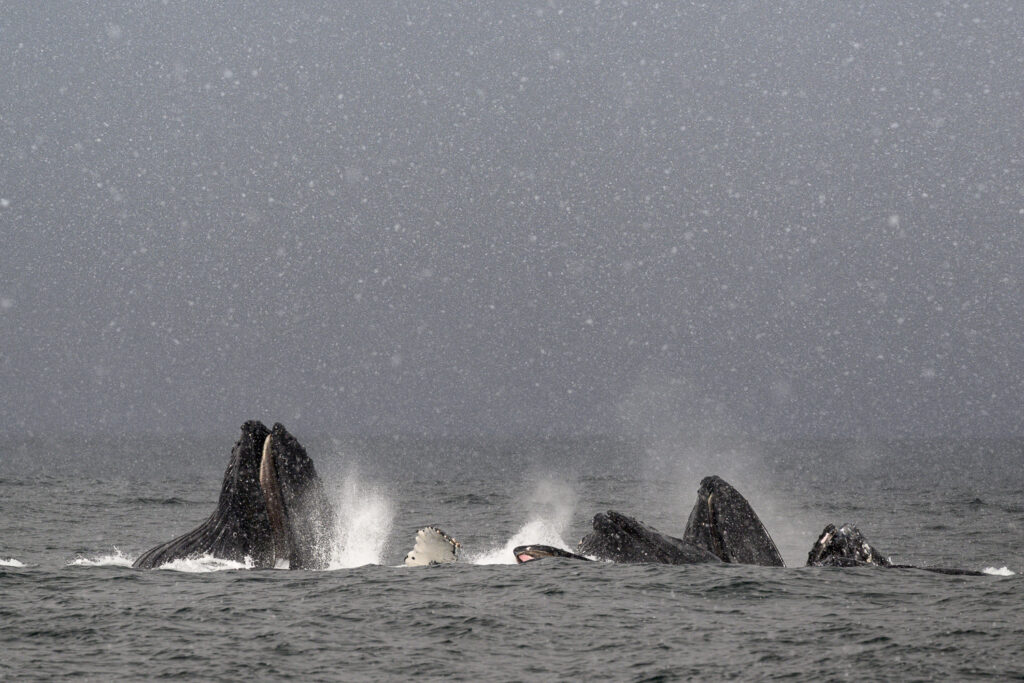
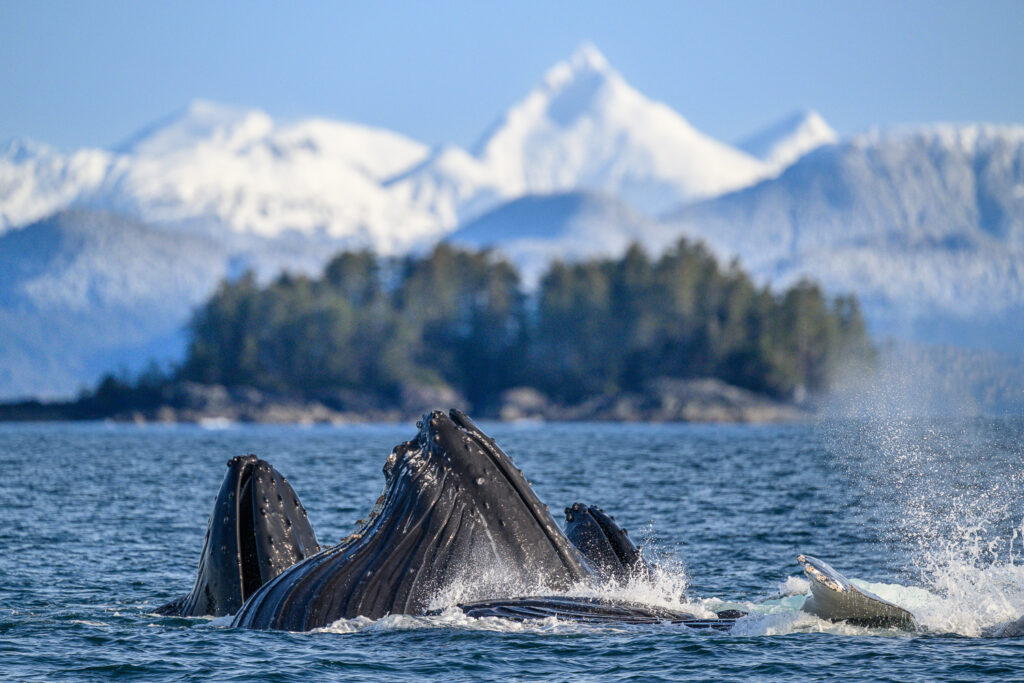
Four seasons in a day. One one day during the second week a blizzard swept in, but the humpback whales carried on feeding regardless. Two hours later we were enjoying watching the same behaviour bathed in sunshine beneath clear blue skies © Nick Garbutt
Inevitably photographic success was variable. On some bubble-net events the whales would rise vertically high out of the water, appearing like emerging edifices, yet at other times their angle at the surface was more oblique, and far less ‘showy’. Sometimes they were hundreds of metres away, more often they were closer and occasionally, with heart-stopped suddenness, they erupt so close we could smell their breath (not pleasant – a bit like an amalgam of rotting fish and cabbage). On our first day, I reckon we saw 50 to 60 bubble-net feedings, which Neil referred to as ‘average’. It was more than any of us had ever imagined.
Our second day was if anything more successful, particularly in the afternoon when considerable flocks of gulls (mainly glaucous-winged gulls and mew gulls), proved to be excellent indicators to where the pod of whales would break the surface.
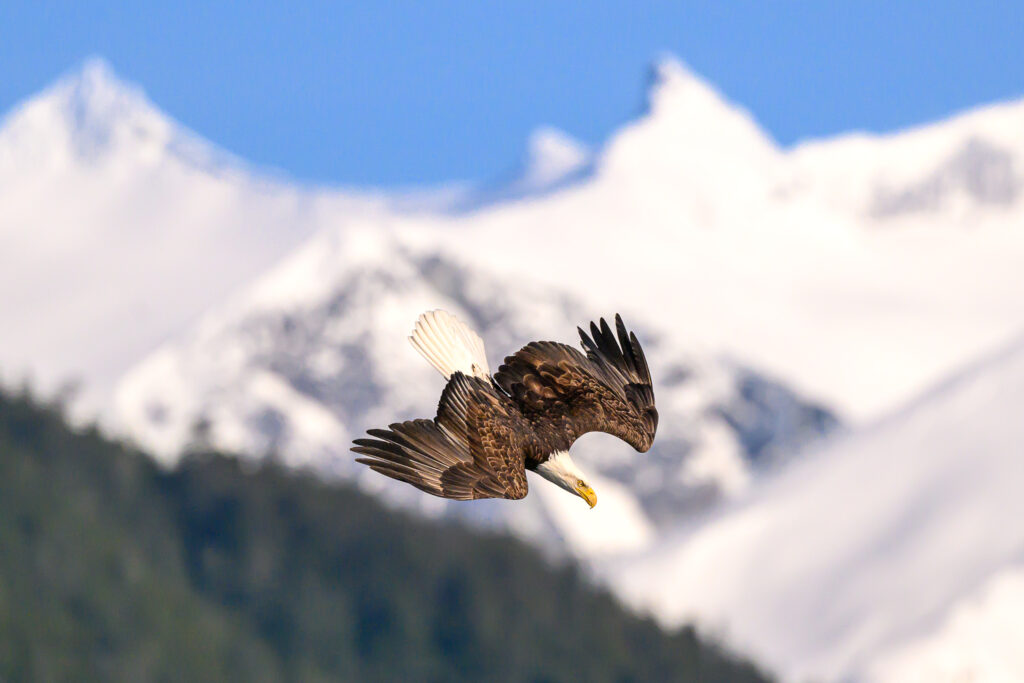
A bald eagle in mid stoop © Nick Garbutt
These first two days effectively set the tone for the majority of both tours each lasting seven days. Of course, there were some relatively ‘poor’ days when bad weather and rough, lumpy seas compromised where we could go and how easy it was to find feeding whales, but over a total of 14 days, there was only one, where no bubble-net feeding was seen (a very poor weather day). In general, ‘poor’ days constituted fewer than 40 bubble net events seen in the day, on ‘moderate’ days we saw perhaps 50 or 60 and on good days (which were more than half) it was 70 to 80 events. There were two exceptional days, where over 100 bubble-net feeds were seen!
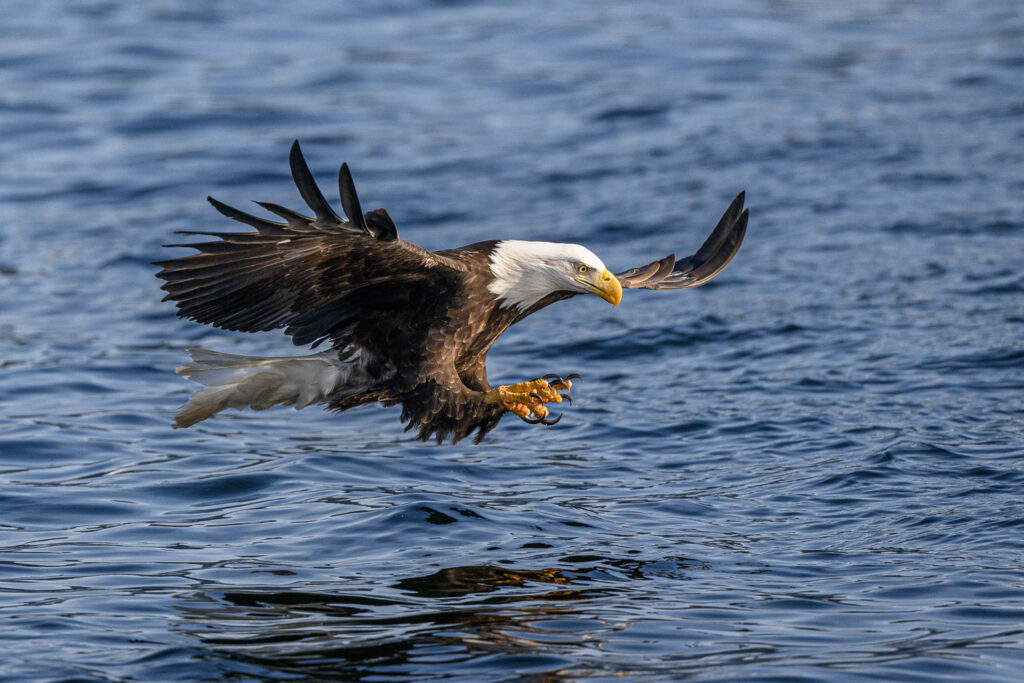
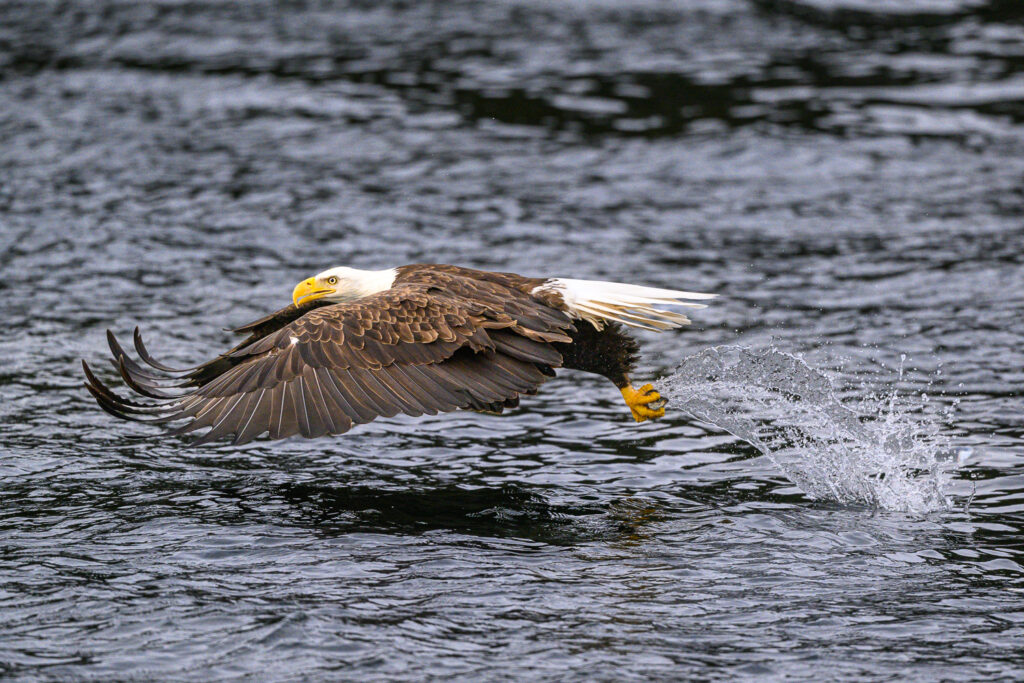
A bald eagle swoops in to pluck a herring from the waves © Nick Garbutt
While the principle focus of these tours was undoubtedly the bubble-net feeding, an unexpected bonus was the opportunity to photograph bald eagles at close quarters. The whales are not the only mammals trying to catch the massing Pacific herring - we do too. The herring constitute a highly prized catch and considerable effort is expended talking advantage of the annual bounty. On a daily basis, numerous boats left the harbour in the hope the Alaska Fish and Wildlife Department would officially open the herring fishery. Test catches were made to assess whether the schools of fish (and their roe which is the primary commercial commodity) were at an appropriate stage of maturation to harvest. Until this is just right, no fishing is allowed. But each time there was a test catch (called a ‘set’) dozens of bald eagles would gather to take advantage of the easy pickings falling from the nets. With numerous dead and dying fish floating on the surface and the eagles were on hand to swoop in for an easy meal. It made for some great image opportunities, with eagles set both against the majestic mountain backdrops or diving at speed and skimming over the waves to deftly pluck a fish from the waves.
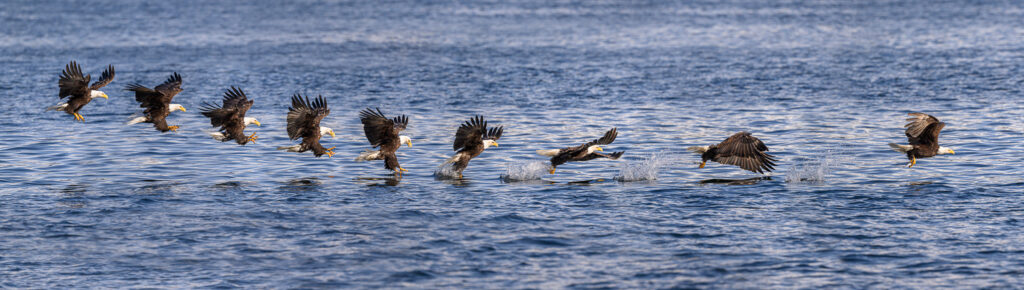
A composite of nine consecutive frames, shows the precision and skill of a bald eagle © Nick Garbutt
Suggested Photo Equipment for this Tour
This is a straightforward trip to pack for, as there is little variation across most of the photographic opportunities. Whales, other mammals and birds are photographed at between 20m and 100m distance, so the majority of opportunities are covered with a decent telephoto zoom lens. This is also one of the few (perhaps the only) tour where a tripod is not required. All photography from the boat is hand-held.
- DSLR or mirrorless camera body
- wideangle to medium telephoto zoom (e.g. 24-120mm or similar)
- medium to long telephoto zoom (e.g. 100-400mm or 100-500mm or similar)
All images shown here were taken with Nikon Z9 and Nikkor Z 100-400mm or Nikkor 500mm PF. Some images are stitches of two or more adjacent images.
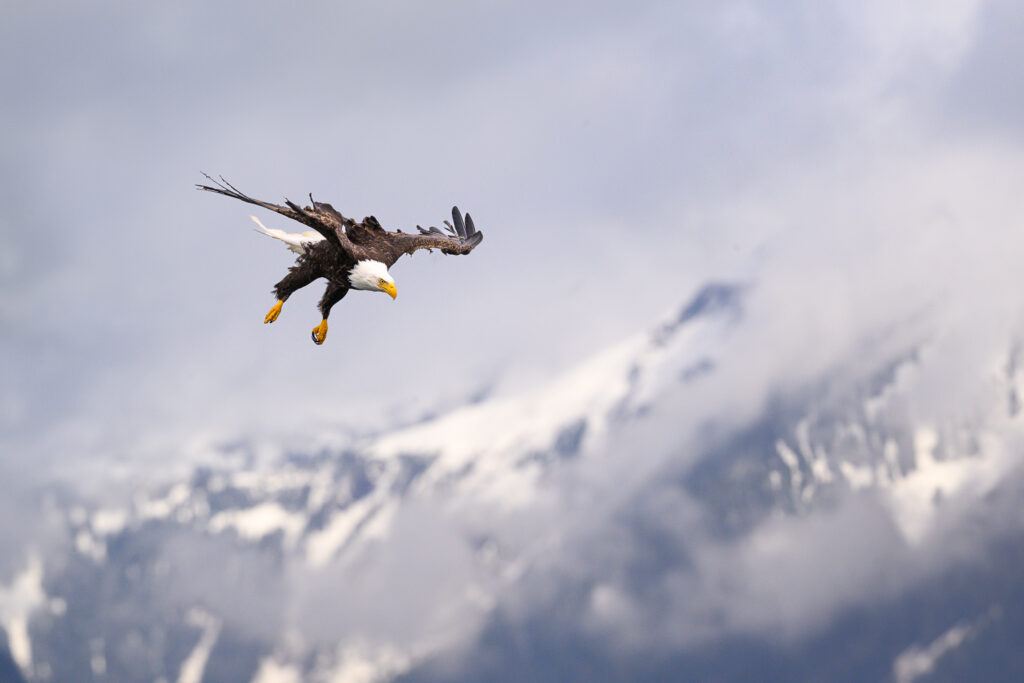
A bald eagle against an imposing mountain backdrop © Nick Garbutt